In just half a month, the domestic thermal coal market has entered a new phase. In the international seaborne coal market, downstream buyers have adopted a wait-and-see approach, and purchases of Indonesian coal have been paused.
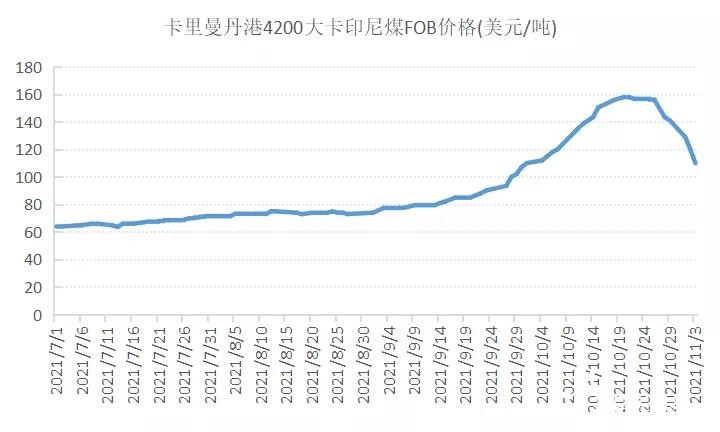
At the end of October, faced with a sudden sharp drop in China's domestic coal market, seaborne market transactions were sluggish. Indonesian miners worried that falling Chinese coal prices might be detrimental to them, but some remained relatively optimistic, believing the price drop was only a temporary correction. One Indonesian miner said: "At least from the producer's perspective, many Chinese power plants still have procurement demand, so prices may correct somewhat, but the extent will be limited." Although there were still some inquiries from China, market uncertainty led producers to hold tightly to their remaining last few cargoes. They were not in a hurry to sell because they had very few December cargoes left to offer; only those still holding November cargoes were eager to sell. The FOB price of 4,200 kcal Indonesian coal at Kalimantan ports briefly stabilized at around $155-158/t, then fell slightly to $141/t on October 29.
Entering November, the decline in Indonesian coal prices widened, dropping $10/t for three consecutive days. As of November 3, the FOB price for 4,200 kcal coal at Kalimantan ports was $109.95/t. Some Chinese buyers and traders renegotiated deals, requesting deferred payment or delivery, forcing Indonesian miners to readjust loading schedules. Meanwhile, heavy rains in Kalimantan severely affected production at small and medium-sized mines; workers had to pump water out of open-pit mines before operations could continue. Regarding the seaborne market, miners are no longer optimistic. Considering that supply remains tight due to weather, they expect export prices may rebound by the end of November, but will not return to historical highs.
Under current market conditions, concluding deals at fixed prices is very risky, so everyone is waiting. One Indonesian trader believes the price correction was overdue and is "a bubble that has been waiting to burst." Another miner said they are re-determining more appropriate offer levels.
For buyers in the Philippines and Vietnam, the downward price trend is a positive signal, but since export prices remain beyond the affordability of most buyers, no agreements have been reached yet. Indian buyers have also stayed out of the market, partly due to the Diwali holiday in India and partly because they are waiting for prices to cool further. According to data from India's Central Electricity Authority, as of November 1, inventory at Indian power plants increased further to 10.96 million tons, with an average of 6 days of usable stock. The number of plants with 3 days or less of usable stock decreased to 47 from 60 a week earlier.
In addition, Indonesia's Ministry of Energy and Mineral Resources set a maximum FOB price cap of $90/t for the thermal coal reference price (HBA) for the cement and fertilizer industries from November to March next year, while the price cap for state utility PLN remains at $70/t. This year, due to tight global supply and strong demand from China, Japan, and South Korea, although prices have fallen, export prices remain high. Miners said: "We have fulfilled our domestic obligations and do not need to supply cement plants and fertilizer plants at lower prices. Companies prefer to export; selling to domestic cement and fertilizer plants should also be at market prices, otherwise the upper limit of the reference price should be raised." According to Platts data, the average FOB price of 5,900 kcal thermal coal from Indonesia in October was $198.57/t.