I. Vale
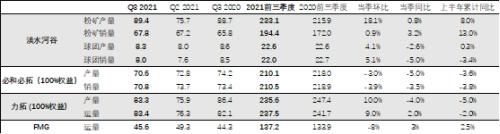
In the third quarter, Vale's iron ore fines production was 89.4 million tonnes, up 18.1% quarter-on-quarter and 0.8% year-on-year. Currently, Vale's production in the first three quarters has completed 70%-74% of its full-year guidance, which is a relatively normal shipping pace. Based on its announcement that full-year production is expected to fall at the lower-middle end of the guidance range, if we calculate based on a full-year production of 320 million tonnes, then Vale's fourth-quarter production is expected to be around 87 million tonnes, down 2.7% quarter-on-quarter and up 2.9% year-on-year.
II. Rio Tinto
Rio Tinto's third-quarter iron ore production was 83.3 million tonnes (100% equity basis), up 10% quarter-on-quarter and down 4% year-on-year. In this report, Rio Tinto lowered its full-year shipment guidance to 320-325 million tonnes (previously expected at the lower end of 325-340 million tonnes). We believe the impact of Rio Tinto's downward revision of its iron ore shipment target is relatively small. Calculated at 320 million tonnes, Rio Tinto's fourth-quarter shipments would be approximately 82.5 million tonnes, down 1% quarter-on-quarter and down 7% year-on-year.
III. BHP
BHP's third-quarter iron ore production in Western Australia was 63.3 million tonnes (71 million tonnes on a 100% equity basis), down 3% quarter-on-quarter and down 4% year-on-year, with its FY2022 production guidance unchanged. Overall, BHP's production and sales both declined in the third quarter due to maintenance, but since it has not adjusted its annual shipment target and stated that the related negative impacts have been mitigated, combined with seasonal production patterns, we expect BHP's fourth-quarter production to be basically flat.
IV. FMG
FMG's third-quarter iron ore shipments were 45.6 million tonnes, up 3% quarter-on-quarter, setting a new record for first-quarter shipments in a fiscal year. The previous mine accident did not affect the full-year production and shipment targets. From a seasonal perspective, FMG's fourth-quarter shipments may rise slightly quarter-on-quarter, and based on current production and sales, FMG is expected to well achieve its FY2022 shipment target.
Overall, the Big Four miners' production and sales in the third quarter of 2021 increased both quarter-on-quarter and year-on-year. Based on each company's latest production guidance and shipment status, we expect the overall supply from the Big Four miners to decline slightly quarter-on-quarter in the fourth quarter.
Table 1: Production and sales data of the four major miners (million tonnes) |
|
Data source: public information, compiled by SDIC Essence Futures |
The following is a more detailed expansion of the quarterly reports of the four major miners:
I
Vale
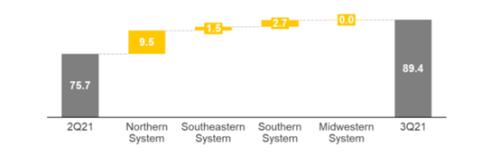
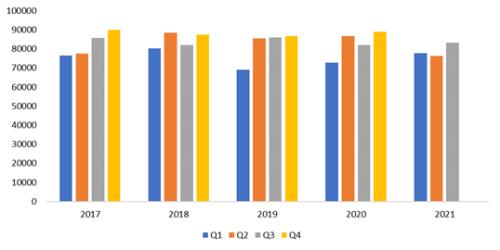
Vale's third-quarter iron ore fines production was 89.4 million tonnes, up 18.1% quarter-on-quarter and up 0.8% year-on-year from the third quarter of last year. The increase in production mainly came from the seasonal improvement in weather in the Northern System, which raised output at Serra Norte and S11D (+9.5 million), while other mining areas also contributed positively to the production growth thanks to improvements in various conditions and increased third-party purchases (+4.2 million). Vale's third-quarter pellet production was 8.3 million tonnes, up 4.1% quarter-on-quarter and down 2.6% year-on-year, still constrained by the supply of raw materials.
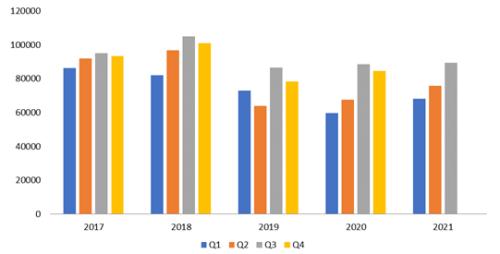
Figure 1: Vale's quarterly production (thousand tonnes) |
|
Data source: public information, compiled by SDIC Essence Futures |
Vale stated that its production and sales strategy depends on market conditions and that, relative to volume, it places greater emphasis on value and on maximizing profit, so in the fourth quarter it will reduce production of low-margin high-silica products by 4 million tonnes. Vale said this move will not affect its full-year production guidance target (315-335 million tonnes), but production is expected to be in the lower-middle part of that guidance range. Vale also noted that if the market remains weak in the future, it will reduce production of low-margin products by 12-15 million tonnes in 2022 and will also adjust its purchases from third-party mines.
In terms of sales, Vale sold a total of 75.88 million tonnes of fines and pellets in the third quarter, up 1.3% quarter-on-quarter from the second quarter. There is a gap of 13 million tonnes between sales and production, mainly because Vale reduced sales of low-margin high-silica products in September in line with market prices, as well as inventory transfers along the supply chain. If the iron ore market improves in the fourth quarter, the above issues will be resolved.
By region, Vale's production increase in the third quarter was mainly attributable to higher output in the Northern System under favorable weather, while production in the Southeastern and Southern Systems also grew to some extent due to factors such as facility improvements.
Figure 2: Attribution of Vale's Q2 production changes by region |
|
Data source: public information, compiled by Guotou Anxin Futures |
Northern System
The Northern System's third-quarter production rose 21.9% quarter-on-quarter, mainly due to favorable weather and less rainfall. However, compared with the third quarter of last year, production remained relatively low, mainly due to licensing delays and processing issues at the S11D ore body. Vale said it will install the remaining 3 ore crushers in the fourth quarter of this year and in 2022, which will increase S11D's capacity next year.
Southeastern System
The continued improvement in the Southeastern System was mainly due to higher quality of run-of-mine ore at the Itabira and Mariana mines and greater availability of hematite in the Brucutu area.
Southern System
The Southern System's better performance was mainly due to improved dry processing at the Vargem Grande mine, higher purchases of third-party ore and full capacity at the Fabrica mine. In addition, with the completion of commissioning of the remote conveyor at the Vargem Grande dam in the future, its capacity is expected to increase by 6 million tonnes.
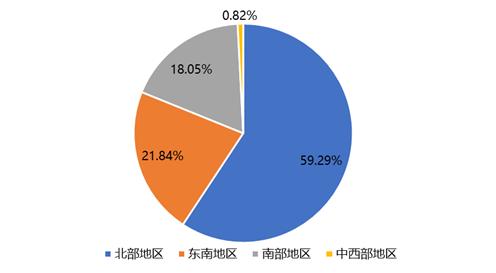
Figure 3: Vale's Q3 production share by region |
|
Data source: public information, compiled by SDIC Essence Futures |
Currently, Vale's production in the first three quarters has completed 70%-74% of its full-year guidance, which is a relatively normal shipping pace and gives it the capacity to meet the lower bound of its 2021 production guidance of 315 million tonnes. Based on its announcement that full-year production is expected to fall in the lower-middle part of the guidance range, and calculating on the basis of full-year production of 320 million tonnes, Vale's Q4 production would be approximately 87 million tonnes, down 2.7% quarter-on-quarter and up 2.9% year-on-year.
II
Rio Tinto
Rio Tinto's Q3 iron ore production was 83.3 million tonnes (100% equity basis), up 10% quarter-on-quarter and down 4% year-on-year. Q3 shipments were 83.4 million tonnes (100% equity basis), up 9% quarter-on-quarter and up 2% year-on-year. Rio Tinto stated that the year-on-year decline in shipments was mainly due to heritage protection issues and delays in the Robe Valley replacement project. SP10 production increased in Q3 and will continue into Q4.
Figure 4: Rio Tinto Q3 production and sales (100% equity) (thousand tonnes) |
|
Data source: public information, compiled by SDIC Essence Futures |
In this report, Rio Tinto lowered its full-year shipment guidance to 320-325 million tonnes (previously the lower end of the 325-340 million tonne range), mainly due to labor shortages that delayed the Gudai-Darri and Robe Valley mining projects. In addition, Rio Tinto lowered the shipment target for its Canadian company's pellets and concentrate to 9.5-10.5 million tonnes (original target was 10.5-12 million tonnes).
Figure 5: Rio Tinto shipment targets (million tonnes) |
|
Data source: public information, compiled by SDIC Essence Futures |

We believe the impact of Rio Tinto's downward revision of its iron ore shipment guidance is relatively small. On the one hand, Rio Tinto had previously expected full-year shipments at the lower end of its original target, 325 million tonnes, and the revised target is only 5 million tonnes lower, so the impact in volume terms is small. On the other hand, based on Rio Tinto's shipment performance this year, cumulative shipments to date are about 5 million tonnes lower than the same period last year. The revision is basically in line with the actual situation and market expectations, and if Rio Tinto can maintain its current shipment pace, it is highly likely to achieve the new full-year shipment target. Calculated at 320 million tonnes, Rio Tinto's fourth-quarter shipments would be approximately 82.5 million tonnes, down 1% quarter-on-quarter and down 7% year-on-year.
III
BHP
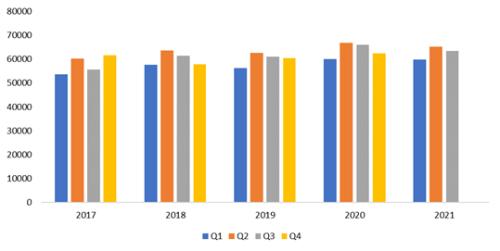
BHP's Western Australia iron ore production in the third quarter was 63.3 million tonnes (71 million tonnes on a 100% equity basis), down 3% quarter-on-quarter from the second quarter and down 4% year-on-year from the third quarter of last year. Its FY2022 production guidance remains unchanged at 246-255 million tonnes (278-288 million tonnes on a 100% equity basis). The decline in BHP's third-quarter production was mainly due to more quarterly routine maintenance schedules and temporary railway labor shortages caused by the pandemic, but the situation improved in September. In addition, strong mine operations and optimization of the mining cycle at Yandi partially offset the negative impact.Brazil's Samarco pellet production in the third quarter was 1 million tonnes, and its production target of 3-4 million tonnes for fiscal year 2022 also remains unchanged.
Figure 6: BHP quarterly production (85% own equity + Samarco production) (thousand tonnes) |
|
Data source: public information, compiled by Guotou Anxin Futures |
BHP's South Flank mine remains in the process of ramping up production, and the target of raising capacity to 80 million tonnes (100% equity) within the next three years remains unchanged. In addition, on September 7, 2021, BHP received approval to increase the operating capacity of Port Hedland to 330 million tonnes (100% equity). BHP's short-term goal remains to stabilize capacity at 290 million tonnes and then gradually ramp up production in the medium term. To achieve the above goals, BHP's board of directors recently approved a port project, which is expected to start in December this year.
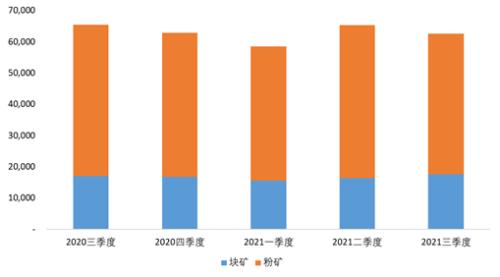
In terms of sales, BHP's total sales in Western Australia in the third quarter were 62.59 million tonnes (70.82 million tonnes under 100% equity), down 4.1% quarter-on-quarter and down 4.4% year-on-year from the third quarter of last year. By product, lump sales were 17.55 million tonnes, up 6.9% quarter-on-quarter, and fines sales were 45.04 million tonnes, down 7.8% quarter-on-quarter.
Figure 7: BHP sales by product (85% own equity) (thousand tonnes) |
|
Data source: public information, compiled by Guotou Anxin Futures |
Overall, BHP's production and sales both declined in the third quarter due to maintenance. However, since it did not adjust its annual shipment target and stated that the related negative impacts have eased, combined with the seasonal pattern of production, we expect BHP's fourth-quarter production to be basically flat.
Four
FMG
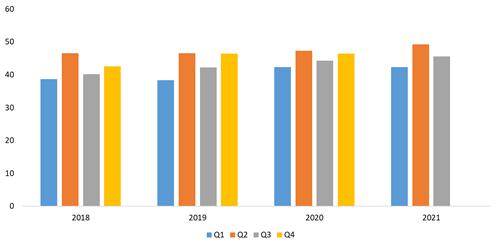
FMG's third-quarter iron ore shipments were 45.6 million tons, up 3% quarter-on-quarter and a record high for the first quarter of a fiscal year; iron ore processing and rail transportation volumes also hit record highs. In addition, despite rising inflationary pressures, FMG's third-quarter C1 cost remained unchanged at 15.25 USD/wet ton, thanks to the good performance of the entire supply chain and the continuous increase in output at the Eliwana mine. FMG maintained its FY2022 shipment target of 180-185 million tons unchanged.
Figure 8: FMG quarterly shipments (thousand tons) |
|
Data source: public information, compiled by Guotou Anxin Futures |
FMG also stated that the Iron Bridge project currently under construction will provide high-grade ore with 67% iron grade in the future, with annual output reaching 22 million tons, and first production is scheduled to start in December 2022. In the past quarter, key progress was made in the facility construction of the Iron Bridge project.
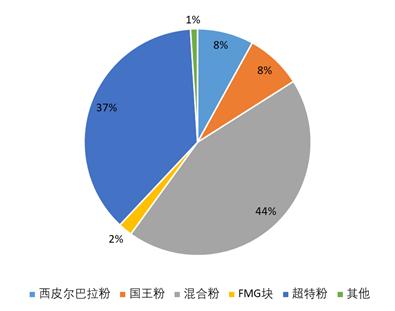
By product type, FMG's third-quarter output of blended fines and super special fines reached 20 million tons and 16.8 million tons, respectively, accounting for 44% and 37% of all products, further increasing their shares quarter-on-quarter; output of other products such as lump ore and West Pilbara fines declined.
Figure 9: FMG shipment volume share by product type |
|
Data source: public information, compiled by SDIC Essence Futures |
FMG delivered a solid production and sales performance in the third quarter, and the earlier brief mine incident did not affect its full-year production and shipment targets. From a seasonal perspective, we expect FMG's shipments to edge up slightly quarter on quarter in the fourth quarter, and based on current production and sales conditions, FMG is well positioned to meet its FY2022 shipment target.
V
Summary
Overall, the four major miners all posted quarter-on-quarter and year-on-year increases in production and sales in the third quarter of 2021, with Vale and Rio Tinto showing notable quarter-on-quarter gains, while BHP and FMG saw slight declines due to maintenance and seasonal effects. Based on each company's latest production guidance and shipment performance, we expect the overall supply from the four major miners to edge down slightly quarter on quarter in the fourth quarter, mainly as supply from Vale and Rio Tinto weakens modestly; Vale, in particular, has proactively cut shipments of lower-margin products in response to market conditions.