China's first autonomous container ship, the "Zhifei", was successfully launched from the Qingdao Shipyard and sailed to China's first intelligent ship test site in the waters near Qingdao Blue Valley. According to the plan, the "Zhifei" will be delivered for operation after completing the project's full-scale intelligent navigation tests at the Qingdao Offshore Ship Intelligent Navigation Experimental Test Site.
It is understood that the 300TEU intelligent container commercial ship "Zhifei" is China's first coastal container transport ship with unmanned intelligent navigation capability that meets the requirements of autonomous navigation testing, and is also the world's largest intelligent navigation ship currently under construction. As a ship implementing a series of achievements from a National Key R&D Program project, the construction of the "Zhifei" is of great significance for China's exploration and mastery of independent technologies for intelligent ship navigation.
The "Zhifei" was led technically by the China Waterborne Transport Research Institute of the Ministry of Transport, invested in and constructed by Qingdao Blue Valley Smart Navigation (Qingdao) Technology Co., Ltd., and designed by Shanghai Jiahao Ship Design Institute. The ship has an overall length of 117.15 meters, a molded breadth of 17.32 meters, a molded depth of 9.9 meters, a design speed of 12 knots, and an endurance of 4,500 nautical miles.
The "Zhifei" will be equipped with an intelligent navigation system independently developed by China, featuring three driving modes: manual driving, remote-controlled driving, and unmanned autonomous navigation. It can achieve intelligent perception and cognition of the navigation environment, autonomous tracking, autonomous route planning, intelligent collision avoidance, automatic berthing and unberthing, and remote-controlled driving. Through multi-network and multi-mode communication systems such as 5G and satellite communications, it can achieve coordination with shore-based production, service, dispatch control, and regulatory institutions and facilities such as ports, shipping, maritime affairs, and navigation support.
In March 2019, the National Key R&D Program project "Integrated Transportation and Intelligent Transportation" Key Special Project 12.1 "Key Technologies for Intelligent Ship Navigation and Control Based on Ship-Shore Collaboration", jointly applied for by the China Waterborne Transport Research Institute of the Ministry of Transport, was officially approved. The project team, with the China Waterborne Transport Research Institute of the Ministry of Transport as the lead unit, was composed of 4 key universities, 6 first-class research institutes, 6 national-level waterway transport technology backbone units, and 4 innovative high-tech enterprises, totaling 21 institutions, bringing together the most advantageous research teams in China's shipping, shipbuilding, artificial intelligence technology, and other related fields from industry, academia, research, and application. The project aims to solve major common key technical problems in integrated transportation and intelligent transportation, focus on the development of new intelligent shipping technologies and the construction of new business forms, and address frontier basic scientific problems and major common key technical problems in ship intelligent navigation and control technology.
In December 2019, Smart Navigation (Qingdao) Technology Co., Ltd. signed a construction contract with Qingdao Shipyard Co., Ltd., and the 300TEU container ship "Zhifei", a demonstration ship for the concentrated application of scientific research achievements from the National Key R&D Program project "Key Technologies for Intelligent Ship Navigation and Control Based on Ship-Shore Collaboration", was officially launched. On May 15, 2020, the "Zhifei" officially started construction.
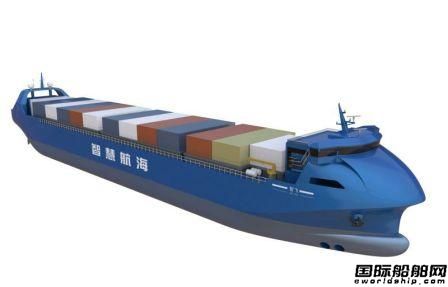
The "Zhifei" will be equipped with an intelligent navigation system independently developed by China and will be the first integrated sample for systematic testing at the Qingdao Offshore Ship Intelligent Navigation Test Site, which is of great significance for China's exploration and mastery of independent technologies for intelligent ship navigation and for building the Qingdao Intelligent Shipping Comprehensive Demonstration Zone.
The "Zhifei" integrates and installs an autonomous navigation system fully independently developed by multiple research institutions and enterprises, including the China Waterborne Transport Research Institute of the Ministry of Transport and Smart Navigation (Qingdao) Technology Co., Ltd. It adopts the large-capacity DC integrated electric propulsion system developed by the 704th Research Institute of China Shipbuilding Industry Corporation, achieving for the first time on the same ship two major technological leaps: DC electrification and intelligence. Smart Navigation (Qingdao) Technology Co., Ltd. is committed to breaking through basic scientific problems and major common key technologies in the field of intelligent ship navigation and control, making a "Qingdao exploration" for the development of the intelligent shipping industry in China and even globally, and contributing Qingdao's strength to the building of a maritime power.
The Qingdao Intelligent Shipping Technology Innovation and Comprehensive Experimental Base was established in Qingdao Blue Valley in May 2018. According to the National Key R&D Program of the Ministry of Science and Technology, the Qingdao Intelligent Shipping Technology Innovation and Comprehensive Experimental Base will implement the "Three Ships" construction plan, and the "Zhifei" is the first experimental ship in the "Three Ships" construction plan. In May last year, China's first unmanned autonomous navigation system test ship, the "Zhiteng", was launched in Blue Valley for test voyages, providing a basis and support for the construction of the 300TEU autonomous container experimental ship "Zhifei". As a comprehensive experimental platform for verifying the achievements of the National Key R&D Program project "Key Technologies for Intelligent Ship Navigation and Control Based on Ship-Shore Collaboration", the "Zhifei" will conduct real-scenario tests at the Qingdao coastal intelligent ship test site after completion, and will then be put into operation on nearby commercial routes, continuously verifying the safety and stability of new intelligent ship navigation technologies. Subsequently, 500TEU and 800TEU intelligent container experimental ships are also planned to be built, continuously verifying the safety and stability of new intelligent ship navigation technologies on domestic coastal routes and ocean-going routes.
As a ship implementing a series of achievements from the National Key R&D Program project "Key Technologies for Intelligent Ship Navigation and Control Based on Ship-Shore Collaboration", the "Zhifei" is of great significance for China's exploration and mastery of independent technologies for intelligent ship navigation and for building the Qingdao Intelligent Shipping Comprehensive Demonstration Zone. It has guiding significance for the formulation of relevant standards and regulations for China's intelligent ship construction and will provide important experience for the development of China's future intelligent ships and intelligent shipping.
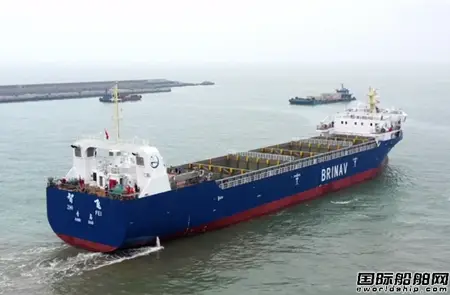
It is reported that the "Zhifei", as a demonstration application of the project's R&D achievements, is currently the world's largest autonomous container ship put into commercial operation. The ship will be operated by Shandong Port Shipping Group and will take the lead in realizing ship-shore collaborative operations between intelligent ships and the unmanned terminal of Qingdao Port in Shandong Port. At that time, the ship will complete experimental subjects such as green power, ship-shore mobile communication networks, smart pilotage, ship-tug integration, and unmanned scheduling and management of container cargo. At the same time, it will also provide full-scale ship certification support for the technical standards of autonomous navigation integrated systems and regulations related to maritime supervision of unmanned ships.