What is the working principle of a diesel engine? Differences between diesel engines and gasoline engines
Working principle of diesel engine
The working process of a diesel engine is actually the same as that of a gasoline engine, with each working cycle also undergoing four strokes: intake, compression, power, and exhaust. However, because diesel engines use diesel fuel, which has a higher viscosity than gasoline and is not easy to evaporate, while its auto-ignition temperature is lower than gasoline, the formation of the combustible mixture and the ignition method are different from gasoline engines.
During the intake stroke, a diesel engine draws in pure air. When the compression stroke is near the end, diesel fuel is pressurized to above 10 MPa by the fuel injection pump and injected into the cylinder through the injector, where it mixes with the compressed high-temperature air in a very short time to form a combustible mixture. Because the diesel engine has a high compression ratio (generally 16-22), the air pressure in the cylinder at the end of compression can reach 3.5-4.5 MPa, and the temperature reaches as high as 750-1000 K (whereas at this point in a gasoline engine, the mixture pressure is 0.6-1.2 MPa and the temperature reaches 600-700 K), far exceeding the auto-ignition temperature of diesel. Therefore, after being injected into the cylinder, the diesel fuel mixes with the air in a very short time and immediately ignites and burns on its own. The air pressure in the cylinder rapidly rises to 6-9 MPa, and the temperature also rises to 2000-2500 K. Driven by the high-pressure gas, the piston moves downward and drives the crankshaft to rotate, performing work, and the exhaust gases are likewise discharged into the atmosphere through the exhaust pipe.
A conventional diesel engine is driven by the engine camshaft and uses a high-pressure fuel pump to deliver diesel to the fuel chambers of each cylinder. This fuel supply method varies with engine speed, making it impossible to achieve the optimal fuel supply at all speeds.
The common rail injection fuel supply system consists of a high-pressure fuel pump, a common fuel rail, injectors, an electronic control unit (ECU), and some pipeline pressure sensors. Each injector in the system is connected to the common fuel rail through its own high-pressure fuel line, and the common fuel rail acts as a hydraulic accumulator for the injectors. During operation, the high-pressure fuel pump delivers fuel to the common fuel rail at high pressure. The high-pressure fuel pump, pressure sensors, and ECU form a closed-loop operation that precisely controls the fuel pressure in the common fuel rail, completely changing the phenomenon where fuel supply pressure varies with engine speed. Its main features are as follows:
1. Injection timing and fuel metering are completely separate; the injection pressure and injection process are controlled by the ECU in a timely manner.
2. The injection pressure, injection start point, and duration for each cylinder can be adjusted according to engine operating conditions, thereby pursuing the optimal control point for injection.
3. It can achieve very high injection pressure and can realize pre-injection of diesel fuel.
Compared with gasoline engines, diesel engines have lower fuel consumption (on average 30% lower than gasoline engines), and diesel fuel is cheaper, so fuel economy is better. At the same time, diesel engines generally have lower speeds than gasoline engines and greater torque than gasoline engines, but they are heavy, noisy during operation, and have high manufacturing and maintenance costs, while their emissions are also worse than gasoline engines. However, with the development of modern technology, these shortcomings of diesel engines are gradually being overcome.
Differences Between Gasoline and Diesel Engines
A gasoline engine draws in a mixture of fuel and air, compresses it, and then ignites the mixture with a spark. A diesel engine draws in only air, compresses it, and then injects fuel into the compressed air. The heat generated by the compressed air ignites the fuel.
Gasoline engines have a compression ratio of 8:1 to 12:1, while diesel engines have a compression ratio of 14:1, or even up to 25:1. Because diesel engines have a higher compression ratio, they are more efficient.
Gasoline engines typically use carburetion, where air and fuel are mixed before the air enters the cylinder or port; or use port fuel injection, where fuel is injected before the intake stroke begins (outside the cylinder). Diesel engines use direct injection, where diesel is injected directly into the cylinder.
The figure below shows a pictorial demonstration of the diesel cycle. Compare it with the gasoline engine animation to see the differences:
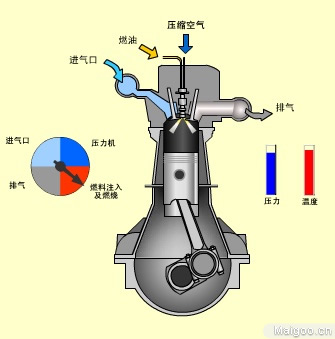
Image courtesy of Baris Mengutay
Note that the diesel engine has no spark plug. It draws in and compresses air, then injects fuel directly into the combustion chamber (direct injection). In fact, it is the heat from the compressed air that ignites the fuel in a diesel engine.
The fuel injector of a diesel engine is its most complex component and has been the subject of extensive experimentation. Because for each specific engine, the position of the injector may vary. The injector must be able to withstand the temperatures and pressures inside the cylinder, while delivering the fuel in a fine mist. Evenly distributing the oil mist circulating inside the cylinder is also a challenge, so some diesel engines use special induction valves, pre-combustion chambers, or other devices to make the airflow swirl in the combustion chamber, or to improve ignition and combustion.
Horsepower
For the definition of horsepower and its impact on engine performance, see horsepower and its applications.
A major difference between diesel and gasoline engines lies in their injection process. Most automobile engines (gasoline engines) use port injection or a carburetor, rather than direct injection. Therefore, in an automobile engine, all the fuel is injected into the cylinder during the intake stroke and then compressed. The compression of the fuel-air mixture limits the engine's compression ratio, because if the air-fuel mixture is compressed too much, it will ignite by itself and cause knocking. Diesel engines, on the other hand, compress only air, so their compression ratio can be much higher than that of gasoline engines. The higher the compression ratio, the greater the horsepower produced.
Some diesel engines contain a type of glow plug (not shown in the figure). When the diesel engine is cold, the compression process cannot raise the air to the fuel's ignition point. A glow plug is an electric heating coil (imagine the heating coil you see in an oven) that ignites the fuel when the engine is cold, thereby starting the engine. Cray Bleston, an experienced heavy equipment technician, believes:
All functions of modern engines are controlled by communication between the ECM and a complex set of sensors that measure everything from R.P.M., engine coolant and oil temperatures, to engine position (i.e., T.D.C.). Today's large engines rarely use glow plugs. The ECM detects ambient temperature and retards engine timing in cold weather, so the fuel injectors fire later. The more the air in the cylinder is compressed, the more heat is generated to assist starting.
Smaller engines and engines without advanced computer controls use glow plugs to solve cold-start problems.
Diesel
If you compare diesel with gasoline, you will find that they are different. They smell different. Diesel is heavier and more oily. Diesel vaporizes much more slowly than gasoline, and in fact its boiling point is much higher than that of water.
Because diesel is heavier, it evaporates very slowly. Compared to gasoline, it contains more and longer carbon atom chains (gasoline is typically C9H20, while diesel is typically C14H30). Diesel undergoes less refining during production, so diesel is cheaper than gasoline.
Diesel has a higher energy density than gasoline. On average, 3.8 liters of diesel contains about 155x106 joules of energy, while 3.8 liters of gasoline contains 132x106 joules. This advantage, combined with the higher efficiency of diesel engines, explains why diesel engines have lower mileage costs than gasoline engines.